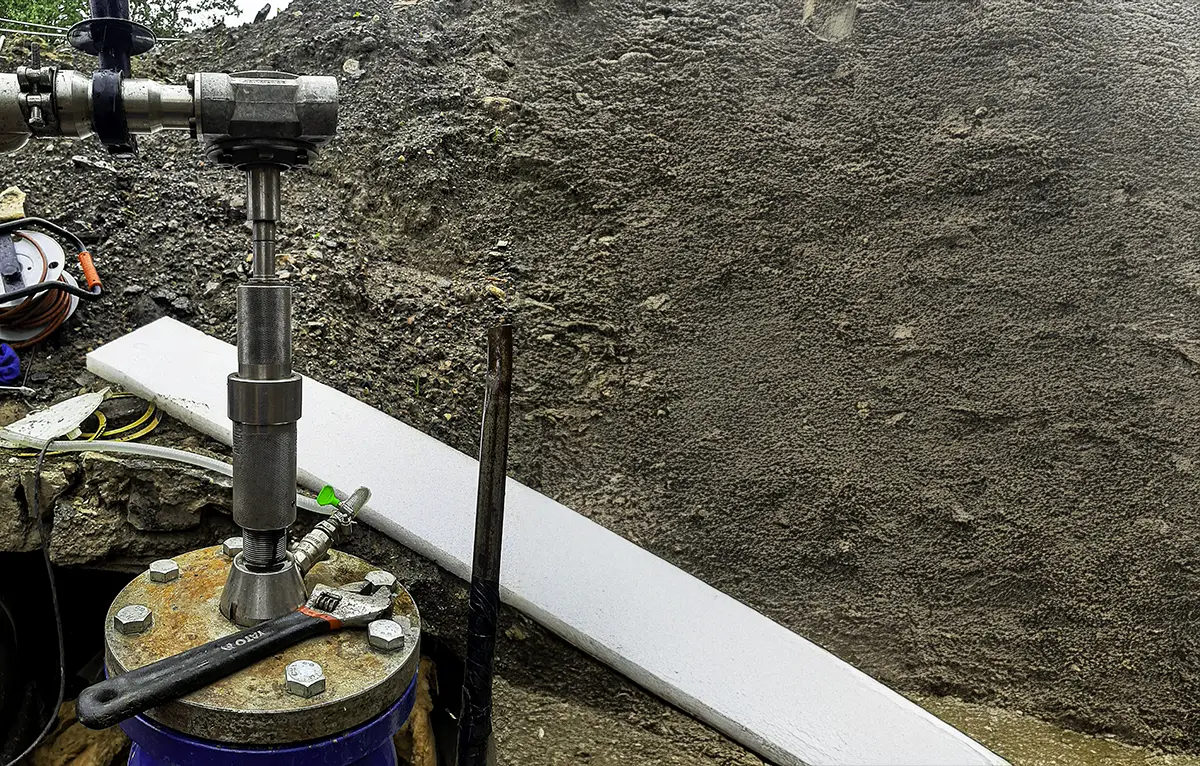
In the district heating industry, where district heating network fittings are installed deep underground, every failure comes with enormous costs, downtime and logistical complications. This applies especially to pre-insulation valves, which become practically inaccessible once buried without disturbing the entire infrastructure.
The market standard today is valves in which the working medium fills the entire stem, with the seal located near the top. In practice, this means the pre-insulated valve operates “wet”, and any damage to the stem almost always leads to a leak. At GLOBTOS, we decided to take a different, safer path. The key to this change turned out to be dry stem technology, which represents a genuine revolution in the design of ball valves for district heating networks.
In most pre-insulated network valves available on the market, network water flows freely into the interior of the stem. The entire control element operates in contact with the medium, and the only barrier against leakage is a seal placed high up, close to the handle or actuator.
In GLOBTOS pre-insulated valves with a dry stem, the seal is located at the very bottom of the stem, directly against the ball. As a result:
This seemingly minor design change significantly improves the operating safety of pre-insulation valves.
Building or upgrading a district heating network is a dynamic environment where an excavator or heavy equipment operator’s mistake is not uncommon. With traditional, “wet” pre-insulated valves, an impact on the protruding stem almost always results in a sudden leak of pressurised medium.
Repairing such a failure usually means:
With GLOBTOS dry stem valves, the situation looks completely different. Even in the event of mechanical damage or bending of the stem:
This is a huge technological advantage for investors, designers and district heating network contractors.
One of the most common problems during project execution is a change in ground level. It happens that a pre-insulation valve turns out, after installation, to be too high or too low relative to the ground level. Thanks to the dry stem design, GLOBTOS fittings offer contractors exceptional flexibility – the stem can be shortened or extended at the production stage, before installation in the network, precisely matching it to the requirements of a specific project.
Shortening the stem involves cutting it to the required height. The dry stem safely withstands machining without risking damage to the fitting or compromising the tightness of the system.
Extending the stem is equally straightforward – if the project requires a greater installation depth, the stem can be extended without any interference with the valve body.
As a result, GLOBTOS pre-insulation ball valves are resistant to design errors and unforeseen ground conditions, and the contractor receives a product perfectly matched to requirements even before installation begins.
At GLOBTOS, we know that every district heating network is different. That’s why we offer production of pre-insulated valves to order, with an individually selected stem length (L).
Regardless of:
we supply ball valves for district heating networks that are perfectly matched to a specific project.
Dry stem technology is a real benefit for the entire investment process. By choosing GLOBTOS pre-insulated valves, you gain:
Do you need a pre-insulation valve with a non-standard stem length? Contact our office in Wrocław – we will design and deliver a solution that eliminates the risk of leakage in your district heating network.
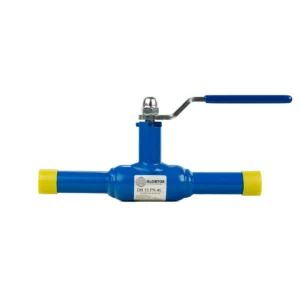
GLOBTOS standard ball valves are the foundation of safe and efficient district heating and industrial systems. Designed for years of…
Materials, construction and standards that determine durability in district heating networksAt first glance, a ball valve is simply a piece…
Hot tapping is the most effective method for modernising and expanding active district heating and industrial pipelines. It enables a…

Valve selection isn’t just an “off-the-shelf purchase.” It’s a decision that determines whether, in five years, you’ll be facing a…
Would you like us to contact you? Leave your contact details and we'll get back to you as soon as possible.


 +48 726 500 100
 shop@globtos.com
 ul. Legnicka 60d, 54-204 Wrocław