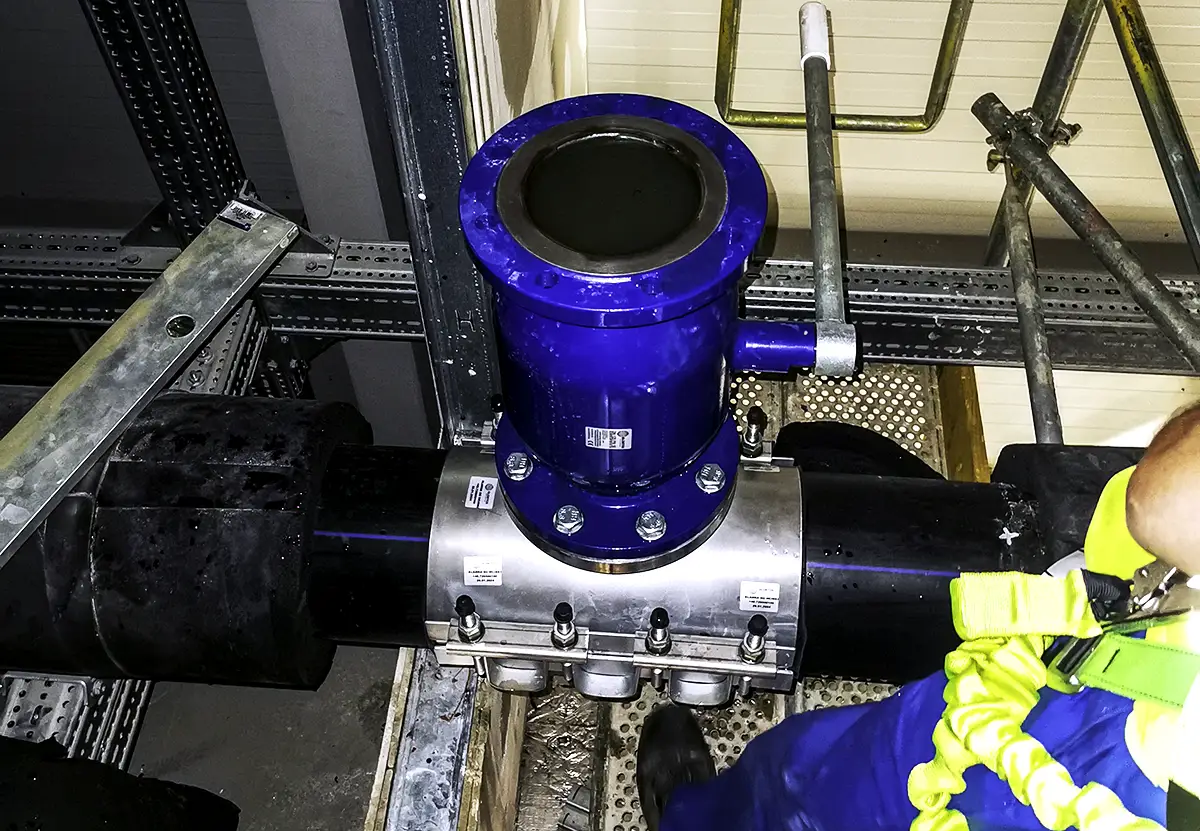
Materials, construction and standards that determine durability in district heating networks
At first glance, a ball valve is simply a piece of steel with a ball inside. In practice, it is a complex safety component designed to operate for 20–30 years under high temperature, pressure — and often without any maintenance whatsoever.
That is why in district heating, a “valve” is never a uniform product. The differences begin with construction, materials and workmanship — and end with the costs of failures, excavations and supply interruptions.
Below, we break down a good ball valve into its essential components.
Valve body – the foundation of the entire construction
The body is the element that:
In district heating networks, what matters is:
A cheap body made from random-grade steel may “hold up” on paper, but in the long run it is most often the component that causes the entire valve to fail.
Ball – the heart of the valve (and the most common source of problems)
The ball is responsible for tightly shutting off the medium. In a good ball valve:
In practice, the quality standard is a stainless steel ball. It ensures that after 10 years the valve:
Seals – invisible, but critical
Seals operate under the most demanding conditions:
In ball valves for district heating, what matters is:
It is the seals — not the ball — that are often the first component to cause leakage failure in cheaper valves.
Stem – control safety
The stem transfers torque from the handle or gearbox to the ball. In district heating, its role is greater than it may seem:
A well-designed stem:
Welds – quality that cannot be corrected after installation
In welded valves, the weld is a structural element, not an afterthought. Its quality determines:
This is why the following matter:
A poorly made weld is a problem that cannot be fixed without excavating the network.
Ball valve materials – what steel for district heating networks?
Which steel for district heating?
In district heating networks, the standard materials are carbon steels rated for elevated-temperature service, such as:
These provide:
Temperature resistance
A valve must perform not only at a given pressure, but also:
Corrosion resistance
Corrosion in district heating is not just rust — it also means:
That is why the right combination of the following is essential:
Ball valve certifications and standards – what truly matters?
In serious projects, certifications are not a marketing add-on — they are a real requirement.
The most important standards and designations
What is required in district heating?
Without these, there is a risk of:
Summary: why “a valve ≠ a valve”
A good ball valve means:
These are the elements that determine whether, after 15 years, a valve:
closes with a single turn — or becomes the source of a costly failure.
GLOBTOS designs and manufactures ball valves for long-term service in district heating networks — where quality, safety and years of peace of mind are what count. If you need to select a valve for a specific network, temperature and operating conditions, contact the GLOBTOS team in Wrocław. It is better to do it right once than to return to the subject with an excavator.

In the construction of modern transmission systems, the selection of valves that combine high mechanical strength with excellent insulation properties…
Valve selection isn’t just an “off-the-shelf purchase.” It’s a decision that determines whether, in five years, you’ll be facing a…
GLOBTOS standard ball valves are the foundation of safe and efficient district heating and industrial systems. Designed for years of…
Hot tapping is the most effective method for modernising and expanding active district heating and industrial pipelines. It enables a…
Would you like us to contact you? Leave your contact details and we'll get back to you as soon as possible.


 +48 726 500 100
 shop@globtos.com
 ul. Legnicka 60d, 54-204 Wrocław